Baby Sleeping In Bouncer (Is It Safe?)
Babies have a funny way of falling asleep in the most random places.
One minute they’re calmly sitting in a bouncer while you finally drink your coffee hot… and the next minute, they’re out cold. It looks peaceful, cozy even, and it’s tempting to just let them nap there.
But a lot of parents quietly wonder if that’s actually okay.
A baby sleeping in a bouncer is super common, but safety-wise, it’s not as simple as it seems.
In this post, we’ll explain why it happens, what the real risks are, and how to handle those accidental bouncer naps without turning it into a habit.
Why Do Babies Fall Asleep In Bouncers So Easily?
It is honestly a bit of a mystery how a piece of mesh and metal can have such a hypnotic effect, but it really comes down to biology and sensory input.

Here are a few things make them extra snooze-friendly:
The slight incline feels snug and secure
Gentle motion mimics being rocked
Vibration can be very calming
The seat “hugs” their body
For a tiny human who just left the womb not long ago, that setup feels familiar. It’s warm, contained, and still. Many babies relax almost instantly once placed inside.
Also Read: Can Baby Sleep In Boppy Lounger Supervised?
And once they relax, sleep isn’t far behind.
Is It Safe For Babies To Sleep In A Bouncer?
No, it is not safe for a baby to sleep in a bouncer.
Bouncers are made for awake time. They’re great for keeping baby entertained or nearby while you get something done. But they aren’t built to support safe sleep.
Pediatricians and safety organizations like the AAP are pretty firm on the "ABC" rule: Alone, on their Back, and in a Crib or bassinet.
Bouncers fail almost every part of that safety test when it comes to long-term sleep.
What Makes Baby Sleeping In Bouncer Risky?
The biggest concern that experts worry about is something called positional asphyxiation.
It sounds terrifying, but basically, it just means that because a baby’s neck muscles are still pretty weak, their heavy head can flop forward onto their chest while they sleep.
If that happens, it can partially or fully block their airway.
Since babies are "obligate nose breathers" and don't have the instinct to just lift their head back up when they are in a deep sleep, this can become a very dangerous situation very quickly.
Plus, it often happens quietly. No sudden struggle. No obvious warning. Just a subtle shift that makes breathing less effective.
Flat sleep surfaces keep the airway open in a more natural way.
That’s why cribs and bassinets are designed the way they are. A bouncer, on the other hand, supports sitting - not resting for long stretches.
What To Do If Baby Fell Asleep In The Bouncer
So, your little one just drifted off and you are staring at them. What now?
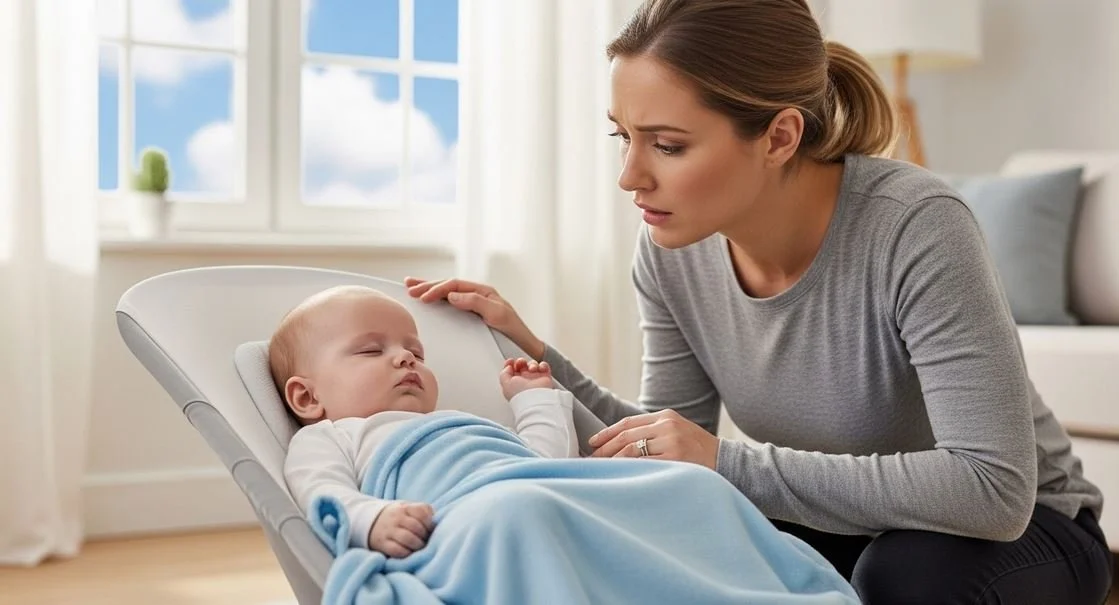
The best move, as painful as it might be to risk waking them, is to transition them to a safe, flat sleep surface like their crib or bassinet.
Also Read: I Have Court But No Babysitter
If they’ve just fallen asleep and seem easy to transfer, that’s the best time to do it. Waiting until they’re deep into sleep makes it harder and often turns into a full wake-up situation.
If you absolutely cannot move them right this second, you must stay in the same room and keep your eyes on them. Check that their chin is lifted off their chest and their face is completely clear of any blankets or toy bars.
But really, don't let this be the plan for the whole nap.
As soon as you have a free hand, make the move. Even a short, interrupted nap in a crib is better than a long, risky nap in a bouncer.
Bouncer Use Done Right
Don't get me wrong, I am not saying you should throw your bouncer in the trash! They are absolute lifesavers when used correctly.
To keep things safe and fun, follow these simple guidelines:
Use during awake time
Keep sessions short
Always supervise
Place only on the floor
Never put a bouncer on a table, couch, or bed. The floor is the safest spot.
They’re perfect for those moments when you need both hands free but still want the baby nearby. Think cooking, quick cleaning, or even just a mental break.
Used this way, they’re a great support tool - just not a sleep space.
Also Read: Baby Brezza Setting 4 Vs 5
Tips To Avoid Bouncer Sleep Becoming A Habit
Some babies start linking the bouncer with falling asleep, especially if it happens often. That can make transitions harder later.
A few simple habits can help prevent that.
Try to catch their "sleepy cues" like rubbing eyes, yawning, or getting a bit fussy, early and get them into the crib before they are totally exhausted.
If they are already nodding off in the bouncer, try to stop the motion immediately so they don't associate the movement with falling asleep.
You can also try to mimic the "cozy" feeling of the bouncer in a safer way.
Using a firm swaddle (if they aren't rolling yet) can give them that feeling of being held and secure while they are on their flat mattress. White noise machines are also great for providing that consistent sensory input that helps drown out the world.
Final Thoughts
It’s not safe for a baby to sleep in a bouncer because the inclined position allows their heavy head to slump forward, which can easily compress their narrow airway and lead to positional asphyxiation.
Since babies have weak neck muscles, they often cannot lift their heads back up to breathe once they are in a deep sleep.
To keep your little one truly safe, they need a firm, flat surface like a crib or bassinet.
This keeps the airway naturally open and eliminates the risks of suffocation or SIDS associated with soft, upright seats.