9 Month Old Flapping Arms? (5 Reasons Why)
You’re sitting there, maybe feeding your baby or watching them play, and suddenly they start flapping their arms like tiny wings. Fast, excited, a little chaotic.
It can catch you off guard, especially if it happens a lot.
And naturally, your brain goes straight to, “Wait… is this normal?”
Good news - most of the time, it absolutely is.
At around 9 months, babies are in a wild stage of growth. Their brains are firing, their bodies are catching up, and they’re constantly testing out new movements. Arm flapping is one of those things that can look a bit unusual but is actually pretty common.
In this post, I’ll explain why your 9 month old is flapping hands, and why you shouldn’t stop it.
Is It Normal For A 9 Month Old To Flap Their Arms?
Yes, it’s normal for a 9 month old to flap their arms.
Babies this age are basically little experiment machines. They repeat movements over and over, not because something is wrong, but because they’re learning how their body works.
Flapping arms is just one of many ways they explore motion and react to what’s happening around them.
You might notice it comes and goes. Some days they do it a lot, other days barely at all.
That’s normal too.
Development at this stage isn’t a straight line - it’s more like bursts of new skills, mixed with random behaviors that show up and disappear.

If your baby is also making eye contact, smiling, babbling, and interacting with you, arm flapping on its own usually isn’t a concern.
Also Read: Moving Baby To Own Room At 3 Months
Why Is My 9 Month Old Flapping Arms?
There’s not just one reason. In fact, there are a handful of really normal explanations, and your baby might be doing it for different reasons at different times.
Here are the most common ones.
#1 Excitement Or Happiness
This is probably the biggest reason 9 month olds flap their arms.
Babies don’t have words yet, so their body does the talking. When they feel excited (like when you walk into the room, or they see their favorite toy) they release that energy physically.
Arm flapping is basically their version of jumping up and down.
You’ll often see it paired with big smiles, squeals, or happy noises.
It can look intense, but it’s actually a good sign. It means your baby is engaged and emotionally expressive.
#2 Frustration
Your 9 month old could be arm flapping if they're annoyed too.
Maybe they can’t reach a toy. Maybe they’re trying to crawl but can’t quite get there yet.
That gap between what they want to do and what they can do can lead to frustration, and since they don’t have the words to explain it, their body reacts instead.
In these moments, the flapping might feel a bit more tense or quick, sometimes paired with fussing or whining.
Totally normal.
It’s part of learning how to deal with emotions.
Also Read: Baby Hates Bassinet
#3 Sensory Stimulation
The world is still very new to a 9-month-old, and everything can feel big and intense.
Lights, sounds, movement, new environments - it can all be exciting or overwhelming.
Arm flapping can be a response to that sensory input. Think of it as their way of processing what’s going on.
You might notice it happens more in busy places, during loud moments, or when they’re taking in something new. Some babies are more sensitive to stimulation than others, so frequency can vary quite a bit.
#4 Practicing Motor Skills And Coordination
This one is easy to overlook, but it’s a big deal.
Babies learn through repetition. They don’t just try something once and move on - they do it again and again until their brain and muscles sync up.
Arm flapping can simply be practice.
They’re figuring out control, strength, and coordination.
At this stage, you’ll also see other repetitive movements like bouncing, rocking, or kicking.
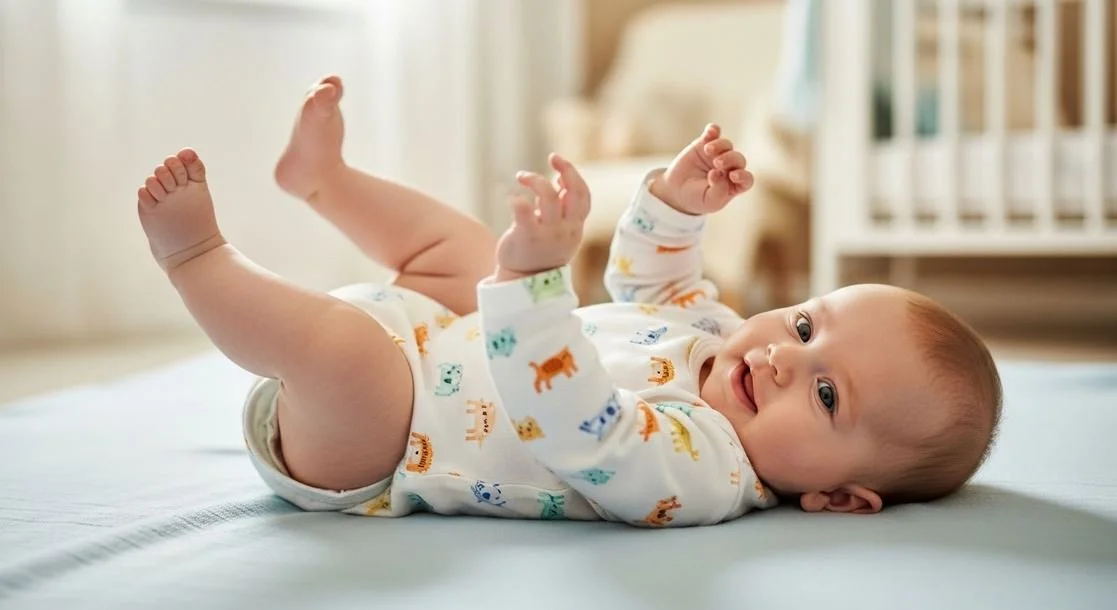
It’s all part of building those early motor skills that eventually turn into more controlled actions like clapping, pointing, and waving.
#5 Self-Soothing When Tired Or Overwhelmed
Sometimes arm flapping isn’t about excitement at all.
It’s actually your baby trying to calm themselves down.
When they’re tired or overstimulated, repetitive movements can feel comforting. It gives them something predictable in a world that can feel like a lot.
If you notice flapping happening more when your baby is nearing nap time or after a busy day, this could be the reason. You might also see other signs of tiredness around the same time, like rubbing eyes or getting fussy.
Should You Try To Stop It?
No, you don’t need to stop it.
If the behavior is part of normal development, there’s no benefit to trying to shut it down. In fact, letting your baby move freely is how they learn and grow.
That said, you can gently redirect if it’s happening during moments where you want to engage them differently.
For example, you can offer a toy, start a game, or interact with them face-to-face. Not to “fix” the flapping, but just to guide their attention somewhere else.
You should support their development while keeping things relaxed and natural.
Is Arm Flapping A Sign Of Autism?
This is the question that pops into almost every parent’s mind at some point.
Arm flapping can be talked about in the context of autism, but here’s the main point: on its own, especially at 9 months, it doesn’t mean much.
A lot of babies flap their arms and go on to develop completely typically. What matters more is the bigger picture like how your baby is communicating, interacting, and responding to the world around them.
So if your baby is engaged, making eye contact, smiling, and showing interest in people, arm flapping by itself is not a red flag.
Also Read: 18 Month Old Can Count To 10
When Should You Be Concerned?
Most of the time, arm flapping is just a phase. Still, there are situations where it makes sense to check in with your pediatrician.
Pay a bit closer attention if arm flapping comes along with other signs like:
Very limited or no eye contact
Not responding to their name at all
No babbling or vocal sounds
Little interest in people
Repetitive movements that happen constantly and are hard to interrupt
Even in these cases, it doesn’t automatically point to anything serious. It just means it’s worth having a conversation and getting a professional opinion.
Early reassurance can go a long way, and if support is needed, it’s better to catch it early.
Bottom Line
Arm flapping at 9 months is completely normal, and it usually comes down to excitement, frustration, sensory input, or just your baby figuring out how their body works.
This stage is full of quirky behaviors.
Some stick around for a bit, others disappear as quickly as they showed up.
Arm flapping tends to fade as babies gain more control and start using more purposeful movements.
If everything else in your baby’s development looks good, there’s usually no reason to stress about it. Keep playing with them, talking to them, and enjoying this phase.
But if you have questions or could use an extra pair of experienced hands, Karen's Nanny Agency can help you find a nanny who's seen it all and is ready to support your family.