Baby Says Mama When Crying (Solved)
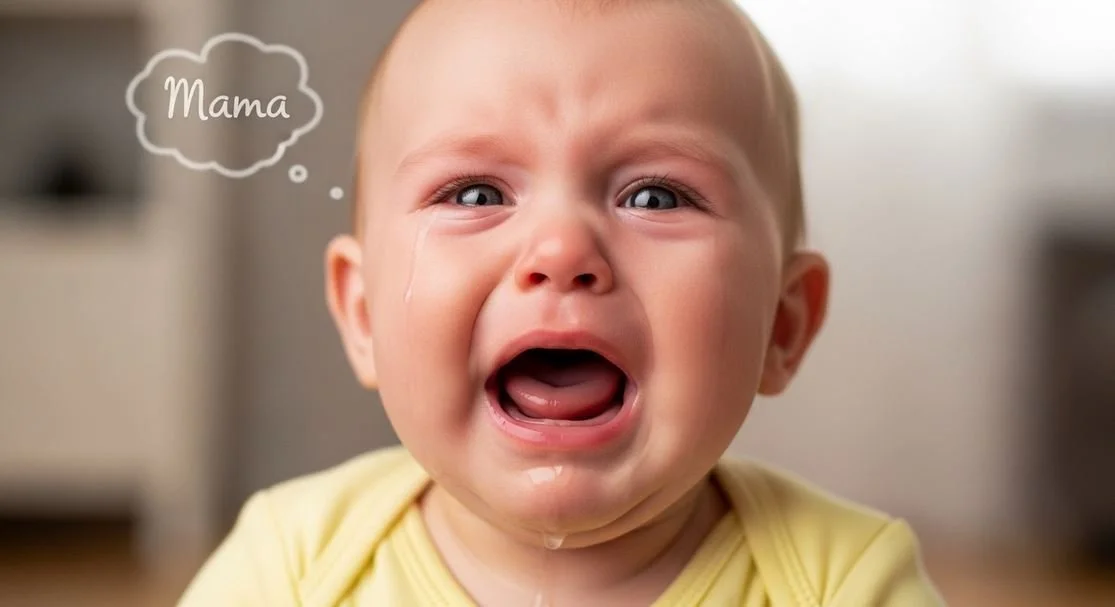
Few things hit straight in the heart like hearing your baby cry and suddenly say “mama.”
Your brain instantly spins up questions.
Do they need me? Are they scared? Is this a real word already? Or is it just a sound?
If you’ve found yourself replaying the moment in your head, or googling this exact phrase at 2 a.m., you’re not alone. This is one of those early parenting moments that feels big, emotional, and slightly confusing all at once.
The good news is that this behavior is far more common than most parents realize, and in most cases, it’s a totally normal part of how babies learn to communicate.
In this post, we’ll explain what’s really going on when a baby says “mama” when crying, and why it’s usually nothing to worry about at all.
Is It Normal For Babies to Say “Mama” While Crying?
Yes, it's completely normal for babies to say mama while crying.
Babies all over the world do this. Some do it early. Some later. Some shout “mamamama” like they’re chanting at a rally. Others whisper it between sobs like a tiny dramatic actor.
All of it falls well within typical development.
This usually happens before “mama” has a clear meaning.
At this stage, it’s more about sounds than words. Babies experiment with noises all day long, and crying just adds volume and urgency to the mix.
What often surprises parents is how emotional it feels to hear. Logically, you might know your baby isn’t truly calling you yet, but emotionally, your heart still goes, “Oh no, my baby needs me.”
Also Read: Blowing In Baby’s Face
Why Babies Say “Mama” When They Cry
There are a few reasons this happens, and none of them involve advanced language skills or secret emotional manipulation.
First, “ma” is one of the easiest sounds a baby can make. It uses the lips, and babies get control of their lips earlier than their tongue. When a baby is upset, tired, or overwhelmed, their brain grabs the easiest sound available.
That sound just happens to be “ma.”
Second, crying limits coordination. When babies cry, they aren’t carefully choosing words. Their brain is busy dealing with big feelings in a very small body.
So instead of varied babbling, you get repetition. “Mamama” is simple, rhythmic, and familiar.
Third, babies hear the word “mama” constantly.
You hear it when people talk to you, talk about you, or talk directly to your baby. Over time, that sound sticks. When they’re distressed, familiar sounds come out first.
And finally, “mama” is deeply tied to comfort. Even before babies understand language, they understand patterns. Mama equals warmth, feeding, holding, soothing.
So when they’re upset, that sound naturally bubbles up.
Also Read: Baby’s Head Fell Back Unsupported
Does It Mean The Baby Is Calling For Mom?
Sometimes yes. Often no. And that’s where parents get confused.
Early on, “mama” is usually just a sound. It doesn’t automatically mean your baby is intentionally asking for you.
They might say “mama” while looking at the ceiling fan or while dad is holding them or while clearly mad at the universe in general.
Intent comes later. And when it does, you’ll feel the difference.
Here are signs that “mama” is becoming more than just noise:
Your baby looks for you when saying it
They reach out or crawl toward you
The sound changes depending on mood, not just crying
Before that stage, it’s best to treat “mama” during crying as emotional expression, not a request. And no, it doesn’t mean they love mom more than anyone else.
Sorry, dads. It’s just phonics.
Baby Language Development And Crying
When adults are upset, we struggle to express ourselves clearly too. Babies are no different, except they’re doing it without actual words yet.

When calm, babies babble with variety. Ba, da, ga, ma, squeals, growls, experimental noises that sound like tiny dinosaurs.
Also Read: Baby Sleeping Sitting Up Folded In Half
When crying, everything narrows. Sounds get louder, more repetitive, and less controlled.
This is why you’ll often hear “mama” only during emotional moments at first.
Calm speech comes later. Emotional sounds come first.
Language development isn’t linear. Babies don’t wake up one day and say, “Today I speak intentionally.” It comes in waves. Messy, inconsistent waves that look different from baby to baby.
Crying just makes the process more noticeable.
What Parents Should Do When Baby Cries And Says “Mama”
Comfort your baby.
Your job in that moment isn’t to analyze speech patterns. Your baby is upset. That’s the priority. Pick them up. Soothe them. Rock them. Do what you normally do.
At the same time, you can gently model language without turning it into a lesson. This helps over time and keeps things relaxed.
A simple approach looks like this:
Respond calmly and warmly instead of correcting
Use natural language like “Mama’s here”
Avoid pushing repetition or testing them
No need to say, “Say mama again!” while they’re crying. No need to overreact. Just be present. Babies learn language best when they feel safe, not pressured.
Also Read: Why Is My Toddler Crossing Fingers?
When To Be Concerned (Rare Cases)
In most situations, there’s no reason for concern at all.
Still, parents like clarity, so let’s talk about the rare cases where a conversation with a professional helps.
If your baby is not babbling at all by around 9 to 10 months, or uses almost no sounds, that’s worth mentioning at a routine checkup. Same goes if your baby shows no response to voices, names, or sounds in general.
Concern isn’t about saying “mama” during crying. It’s about the bigger picture.
Communication includes eye contact, gestures, sounds, reactions, and curiosity.
If something feels off in a broader sense, trust that instinct and bring it up. Most of the time, reassurance is all you’ll get.
Bottom Line
When a baby says “mama” while crying, it’s usually a mix of easy sounds, big feelings, and comfort association. It feels intense because it tugs at your heart, but developmentally, it’s a very normal step along the road to real speech.
You’re not doing anything wrong. Your baby isn’t confused.
And this moment doesn’t predict anything dramatic about the future.
Soon enough, “mama” will come with sticky hands, eye contact, and very specific demands. For now, it’s just one small, sweet sound in a very loud stage of life.
And yes, you’re allowed to feel a little emotional about it anyway.